
How Much Does Water Softener Installation Cost in Maryland?
Published cost guides put water softener installation at $1,100 to $3,000, with a national average of $2,500. One guide prices a salt-based system at $1,200 to $3,800 installed and a dual-tank system at $1,700 to $5,000. Our water softener installation for Maryland wells starts with your lab hardness and iron numbers.
Hard water leaves white scale on faucets and a crust inside the water heater. A water softener takes the calcium and magnesium out before the water reaches your fixtures. The installed price follows the system type and the capacity your water calls for. Plumbing work at the install point adds to it.
The prices below are published national market data from cost guides. Use them to size up a quote, since your own number depends on your lab results and your household. Maryland hardness facts come from the Maryland Geological Survey. We are based in Poolesville and Dickerson and work in Montgomery, Frederick, Carroll, Howard, Washington and Baltimore County.
What does each type of water softener cost installed?
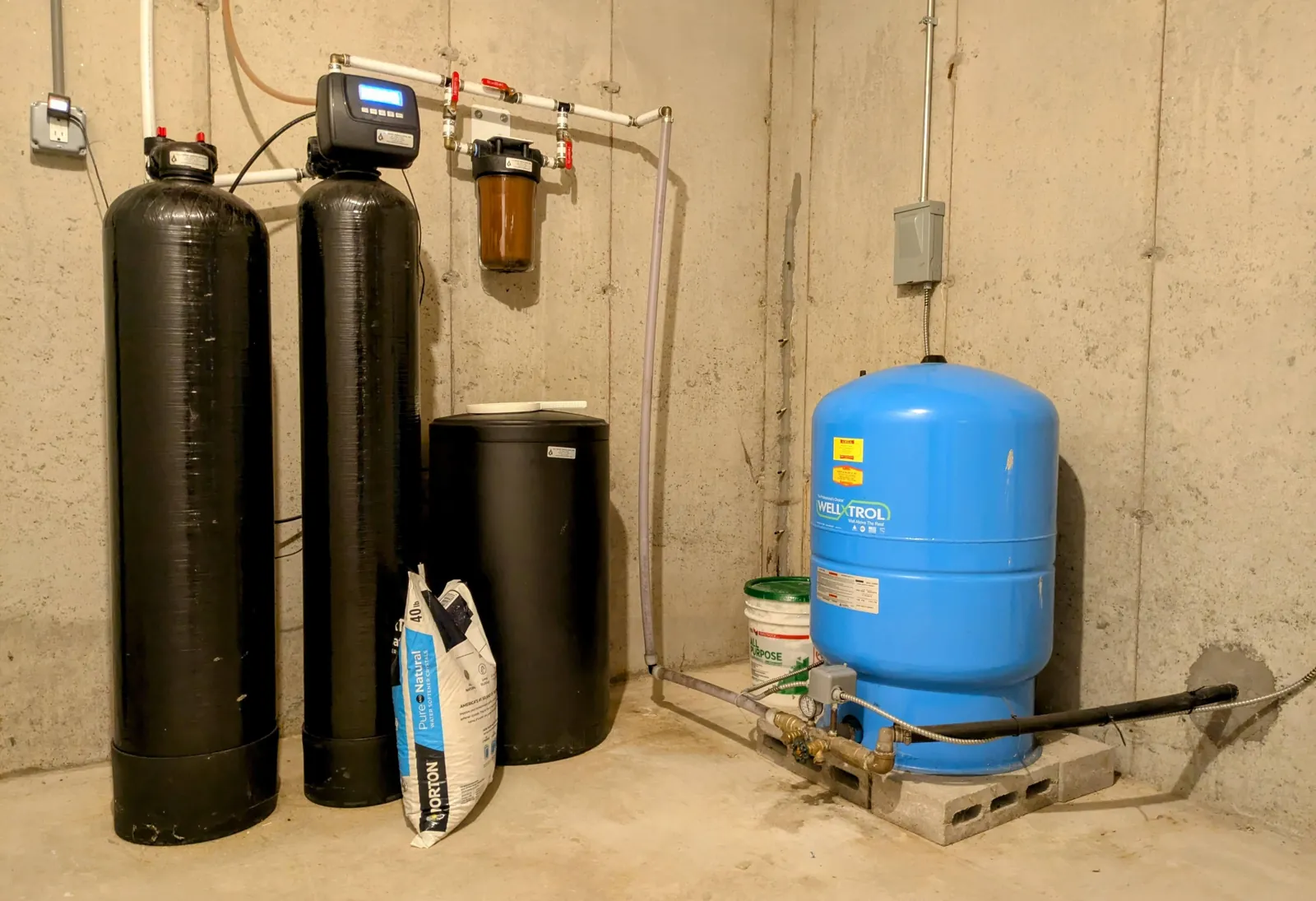
One published guide puts a single-tank salt-based softener at $650 to $1,500 installed. Another puts it at $1,200 to $3,800. A dual-tank system runs $1,700 to $5,000, and a salt-free system runs $1,500 to $4,500. Tank count and unit capacity drive the spread, one guide says.
One guide says most homeowners spend $2,500 on a dual-tank system for a 3 to 4 bedroom home. Its low end, $600, is a small basic descaler for a 1 to 2 bedroom home. Its high end, $7,000, is a multi-tank softening and filtration system for a 5 to 6 bedroom home. A dual-tank unit keeps soft water flowing while one tank regenerates, which suits a large household or very hard water.
Published national installed ranges by system type
| System or job | What it is | Published range |
|---|---|---|
| Single-tank salt-based softener | One resin tank and a brine tank | $650 to $1,500 in one guide; $1,200 to $3,800 in another |
| Dual-tank salt-based softener | Two resin tanks, so soft water keeps flowing | $1,700 to $5,000 |
| Salt-free conditioner | Scale control; hardness minerals stay in the water | $1,500 to $4,500 |
| Softener unit plus a new softener loop | First install where the house has no loop | $600 to $2,000 |
| Softener plus whole-house filtration | Adds a filter for iron or sediment | $1,500 to $10,000 |
| Replacing an existing softener | A new unit on plumbing already in place | $700 to $1,000 |
What moves the price of a water softener installation?
Hardness and household size set the capacity, and larger units cost more. One guide calls the hardness level the biggest factor in which system and size you need. Iron in the water can add a filter ahead of the softener. Plumbing work and hauling away an old unit add to the bill.
Installation labor is about 20 to 30 percent of the total project in one guide. Another prices the labor at $150 to $1,000, by system size and type. Costs rise when more pipe must be cut or the softener sits far from where the water comes in. Some areas require a permit, so check with your county; one guide puts permit fees at $50 to $150.
A first softener in an older house costs more to plumb. One guide budgets $100 to $600 for plumbing changes, such as new connections or a drain line. A dedicated outlet near the unit runs $100 to $250 if one is needed. If the house has no softener loop, another guide puts the loop and the unit together at $600 to $2,000.
A softener takes out colorless iron, an extension guide says, but iron exposed to air or chlorine clogs the resin. Cloudy water can clog it with mud and clay, too. The fix for both is iron and sediment filtration ahead of the softener. For a job that needs both, one guide prices a softener with a whole-house filter at $1,500 to $10,000.
Why do the lab hardness and iron numbers come first?
A softener sized off a guess either runs short or costs more than it needs to. One guide says an undersized unit regenerates more often, with higher salt and water use. An oversized one means you pay for what you will never use. The lab report gives the hardness and iron numbers that set the size.
Lab reports give hardness in milligrams per liter or in grains per gallon. The Maryland Geological Survey puts 1 grain per gallon at about 17.1 mg/L. USGS rates 0 to 60 mg/L as soft and anything above 180 mg/L as very hard, or above 10.5 grains. One guide recommends a large or dual-tank system once the water is that hard.
Many softener sellers offer a free hardness check, but an extension guide advises an independent lab test. It says an independent test will protect you from being oversold. Our certified lab water testing puts the hardness and the iron on one report, and both numbers shape the quote. For lab prices, see what a well water test costs in Maryland.
How hard is well water in Maryland?
It depends on the rock under the well. The Maryland Geological Survey studied the carbonate rocks of the Frederick and Hagerstown Valleys. It found the water is almost always hard or very hard, and water softeners are fairly common there. Outside the valleys, your own lab number is the one that counts.
The valleys are underlain mostly by limestones and dolomites, rock with many sinkholes and large springs. The report ties the chemistry of the valley groundwater to the minerals in that rock. Hard water does not pose a health hazard, the Survey says. The cost shows up as scale in pipes and water heaters, and as soaps and detergents that work less well.
The Maryland Piedmont sits on metamorphic and igneous crystalline rock, the Survey says. Its water is typically slightly acidic and typically contains low amounts of dissolved solids. Acidic water calls for different treatment than hard water, so a Piedmont well can need a different fix. Either way, a water softener sized to your own well starts with the lab report.
What does a water softener cost to run each year?
One guide puts salt or potassium at $50 to $150 a year. Another puts all running costs at $100 to $300 a year, salt and upkeep included. Potassium chloride costs more per bag than salt. One guide says you also need more of it for the same results.
Bag prices explain the gap between salt and potassium. One guide lists salt at $10 to $15 a bag and potassium chloride at $30 to $40. Another guide puts a year of salt at $30 to $100, and a year of potassium at $150 to $350. Upkeep adds more: one guide puts maintenance at $150 to $600, with routine inspections every 2 or 3 years.
On a well, regeneration water comes out of your own supply and goes down the drain. An extension guide estimates about 50 gallons of water for each regeneration cycle. With a septic system, it says to consider the added load on your drainage field from regeneration. Ask your county health department about the drain line before a softener goes in.
Have a hardness number, or only the scale on your faucets? Call (301) 393-7090 to talk through a softener or to book a certified water sample first. We are open 24/7, nights, weekends and holidays included. Estimates are free and written after a look at the property and your lab results. You can also send us your water test results.